Hexe is not one program that draws terminals. It is four layers with one rule between them: the layer that owns a thing is the only layer allowed to change it. The frontend owns pixels, SES owns the session, a pod owns a PTY. Everything else in this documentation is a consequence of that split.
hexe terminal new       # the frontend you look at (aliases: hexe mux, hexe multiplexer)
hexe ses list           # the authority it talks to
hexe pod list           # the daemons holding the actual shells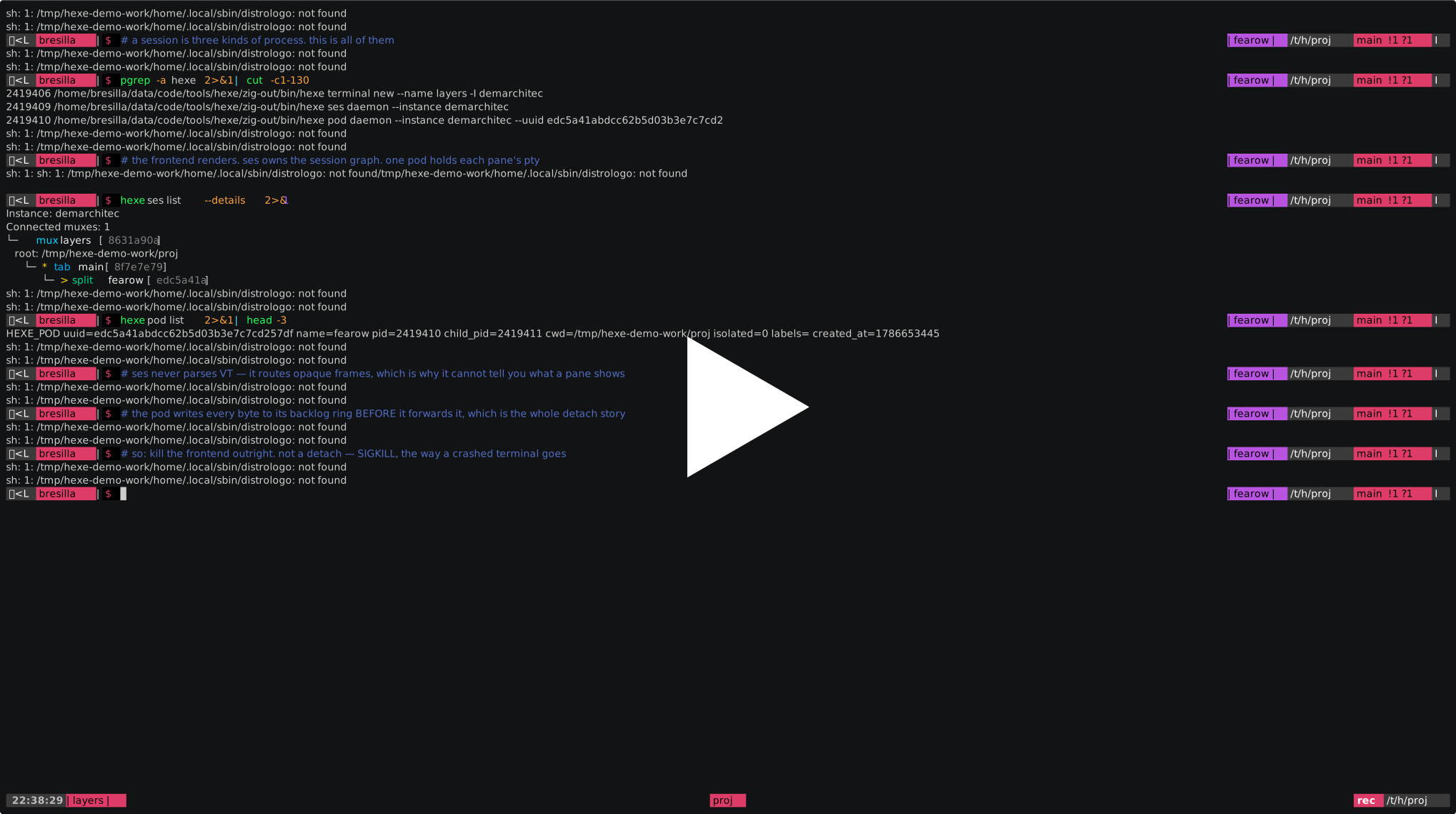
┌────────────────────────┐   what it owns
│ terminal frontend      │   rendering · input · keybindings · popups · status bar
│ hexe terminal          │   float widgets · selection · VT parsing and screens
└───────────┬────────────┘
            │  semantic commands ("split this", "focus left")
            │  ← authoritative session snapshots + VT stream
┌───────────┴────────────┐
│ shared frontend runtime│   attach lifecycle · transport · session projection
│ (in-process)           │   command API · backlog coordination
└───────────┬────────────┘
            │  unix socket (or a liblink tunnel to a remote SES)
┌───────────┴────────────┐
│ SES                    │   the session graph · names and uuids · focus
│ hexe ses daemon        │   detach/reattach · pane ownership · VT routing
└─────┬────────────┬─────┘
      │            │  one connection pair per pane
┌─────┴─────┐ ┌────┴──────┐
│ POD       │ │ POD       │  the PTY fd · the shell process · the backlog ring
│ pod daemon│ │ pod daemon│  cwd / foreground process / title metadata
└─────┬─────┘ └────┬──────┘
    shell        shell
Read it as a chain of things each layer is not allowed to know. The frontend does not know how a pane's shell is started. SES does not know what the bytes flowing through it mean — it never parses VT. A pod does not know it is in a session; it holds one PTY, buffers what comes out of it, and answers whoever connects.
key ─> frontend keybinds ─> (no bind matches) ─> runtime VT channel ─> SES ─> POD ─> PTY ─> shell
and back:
shell ─> PTY ─> POD ─┬─> backlog ring (always, first)
                     └─> SES ─> runtime ─> frontend VT widget ─> screen
The backlog append happens before the uplink write, and that ordering is the whole detach story: if SES is slow, wedged or gone, the pod drops the connection after a bounded stall and keeps running, and the missing bytes are still in the ring for whoever attaches next.
A frontend that reconnects its VT channel may resend frames it is not sure landed. Each input frame
carries a 16-byte (epoch, seq) prefix — epoch identifies a frontend process, seq is monotonic
within it — and the pod is the dedup authority, because the pod is the only process that survives
every reconnect trigger: a slow frontend, a dropped VT channel, a SES crash. A frame whose seq
has already been applied is dropped rather than typed into your shell twice.
The frontend never sends the session. It sends what it wants:
user presses split
    ↓
frontend action           "split horizontal, here"
    ↓
runtime command helper
    ↓
SES                       mutates the canonical graph, assigns uuids, spawns a pod
    ↓
SES publishes session_state
    ↓
runtime rebuilds the projection
    ↓
frontend reconciles its widgets against it
The frontend's copy is a projection: derived, replaceable, and never authoritative. This is why a frontend can be killed at any instant without corrupting anything, and why two frontends attached to one session cannot drift apart.
frontend ─> same runtime ─> liblink transport ─> `hexe session pipe` ─> remote SES ─> remote PODs
The same CTL/VT protocol is tunnelled to a remote SES through an internal bridge command. Nothing above or below the transport layer changes, which is the point: a future web or desktop frontend reuses the same runtime contract rather than reimplementing session semantics.
tmux is the useful comparison because it made the opposite choice deliberately. In tmux the server owns the terminal emulation: it parses VT for every pane, keeps the screen, and clients render what the server tells them. That is a fine design, and it means the server is on the hot path of every byte a shell writes and must understand all of it.
In hexe the daemon that owns the session never parses VT at all. SES routes opaque frames; the VT lives in the frontend (Ghostty's implementation) and the raw bytes live in the pod. The costs land differently:
- A pane's terminal state can be rebuilt from bytes on reattach, so scrollback survives with it.
- Emulation bugs are frontend bugs, not daemon bugs; a wedged VT cannot wedge other sessions.
- The daemon's per-pane memory is a ring buffer, not a screen plus history.
- But the daemon cannot answer questions about screen content —
capture-panehas no equivalent, because SES genuinely does not know what is on any screen.
There is nothing to configure about the architecture, but two environment variables decide which stack a command talks to:
HEXE_INSTANCE |
which stack: sockets live under $XDG_RUNTIME_DIR/hexe/<instance>/. See instances |
HEXE_SESSION |
set inside every pane, naming the session it belongs to |
SES reads five caps from the environment, and two of them are a trap:
HEXE_MAX_CONNECTIONS |
the connection ceiling (default 512) |
HEXE_MAX_PANES_PER_SESSION |
refuses to create more panes in one session |
HEXE_MAX_CONNECTIONS_PER_MINUTE |
an interactive connection rate limit, clamped to the limiter's capacity |
HEXE_MAX_SESSIONS |
parsed and never enforced |
HEXE_MAX_MEMORY_PER_SESSION_MB |
parsed and never enforced |
Every socket is checked at both ends for a same-uid peer, and the runtime and log directories are
created with an ownership check (ensurePrivateDir) — the runtime directory prefers
/run/user/<uid> and only falls back to /tmp when there is no better home.
And the layers can be started by hand when something has gone wrong:
hexe ses daemon --foreground        # usually started automatically by `terminal new`
hexe ses status                     # is it running, and where is its socket
hexe pod list                       # every pod with a metadata file
hexe pod gc --dry-run # sockets and metadata left by pods that died- Uplink write budget: 2 s. A pod writing to a SES that has stopped draining gives up after two seconds and drops the connection rather than blocking its own event loop — which would freeze the user's shell. Recovery is backlog replay.
- Pod handshake budget: 5 s for a peer to deliver its two-byte handshake, read resumably. It used to be a blocking read inside the accept loop, so any local process could connect, send nothing, and freeze a pod — and the shell in it — for the timeout, once per queued connection.
- PTY write buffer: 256 KiB, growing to 16 MiB. Input is never dropped short of that ceiling:
a torn bracketed paste (a lost
ESC[201~) leaves the shell swallowing every later keystroke, so the pane looks permanently frozen. - SES connection ceiling: 512, against 64 registered frontends. Two connections per pane plus two per frontend puts a 30-pane session near 62.
- SES is single-threaded and in the middle. Frontends never connect straight to pods, so a stalled SES is felt by every session on the machine — which is why nearly every wait in it is bounded and budgeted.
- There is no screen in the daemon. Nothing outside a frontend can read what a pane displays.
- The frontend is the only shipped one.
hexe webandhexe syslinkexist as adapters against the same runtime, but they are probes and serving loops, not a UI you would use. - A pod's death is a pane's death. There is no second copy of the PTY.
- Remote needs a reachable SES and a bridge process. It is transport reuse, not synchronisation: nothing is mirrored, and there is no offline mode.
src/frontends/terminal/ |
the frontend: loop_*.zig is the event loop, state*.zig the view state |
src/frontends/core/ |
what any frontend must implement: actions, events, host protocol |
src/core/frontend_runtime.zig, frontend_client.zig, frontend_attach.zig |
the shared runtime |
src/core/session_projection.zig, session_model.zig |
the frontend-side mirror of SES truth |
src/modules/session/ |
SES itself: server*.zig, state.zig, vt_routing.zig |
src/modules/pod/ |
the pod: main.zig, buffering.zig, uplink.zig, input_dedup.zig |
src/core/wire.zig, pod_protocol.zig |
the two wire formats, and the runtime-epoch handshake |
src/cli/commands/ses_pipe.zig |
the remote bridge |
| Layer | Owns | Does not own |
|---|---|---|
| Frontend UI | rendering, keybindings, mouse handling, popups, status bar, terminal-specific view objects | session truth, pane ownership, detach semantics |
| Shared frontend runtime | attach lifecycle, session projection, transport wiring, command API, backlog coordination | canonical session graph |
| SES | canonical session graph, session IDs/names, pane/tab/float structure, focus authority, detach/reattach, pane ownership, VT routing | terminal-specific rendering state |
| POD | PTY fd, shell process, backlog buffer, cwd/process/title metadata | session structure, multi-pane layout |
The terminal frontend is not a shell owner and not a session authority. It is a UI over shared runtime state.
It still has real local state, but that state is visual:
- split/tree widgets
- float widgets
- Ghostty VT render state
- focus ring and selection state
- status bar and popup state
- mouse drag / resize interaction state
That state is a projection of SES-owned session truth, not the canonical session model itself.
terminal frontend
    ->
FrontendRuntime.attachFrontend()
    ->
FrontendClient.connect()
    ->
SES register / attach
    ->
SES returns authoritative session snapshot + backlog info
    ->
runtime builds SessionProjection
    ->
frontend builds view objects
The frontend does not send whole-session truth anymore.
user action
    ->
terminal frontend
    ->
runtime command helper
    ->
FrontendClient semantic command
    ->
SES mutates canonical session graph
    ->
SES publishes authoritative session_state
    ->
runtime updates SessionProjection
    ->
frontend reconciles view state
Examples of semantic commands:
- add/remove tab
- split/create/close/replace
- create/remove/sync float
- focus/tab navigation updates
- pane create/adopt/kill/orphan
keyboard input
    ->
frontend
    ->
runtime/client VT channel
    ->
SES
    ->
target POD
    ->
shell

PTY output
    ->
POD
    ->
SES
    ->
runtime/client VT channel
    ->
frontend VT widget
SES stays in the middle because it owns pane routing and session lifecycle. Frontends do not connect directly to PODs.
frontend detach
    ->
runtime detach request
    ->
SES persists canonical session state
    ->
frontend exits

later:

new frontend
    ->
runtime attach
    ->
SES authoritative snapshot
    ->
runtime projection rebuild
    ->
frontend views rebuilt
No frontend-authored snapshot is the source of truth here. SES is.