An instance is a whole stack — its own SES daemon, its own pods, its own sessions — living under its own socket directory. Two instances on one machine cannot see each other, which is what makes it safe to run a development build of hexe next to the hexe you are working in.
hexe terminal new -I dev        # a stack called dev
hexe ses list -I dev            # its sessions
hexe terminal new -T            # a throwaway stack with a generated name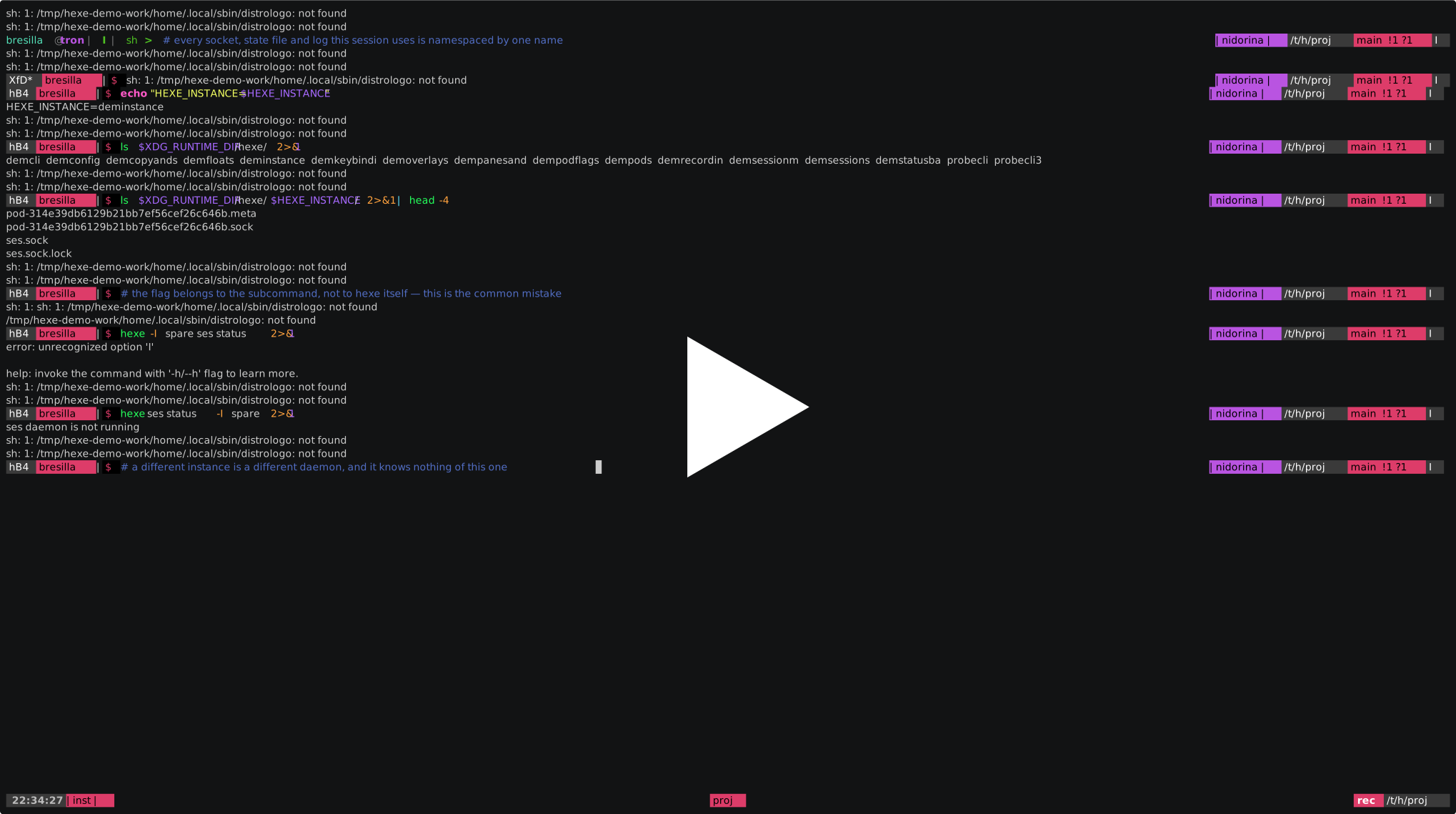
The whole mechanism is a path:
$XDG_RUNTIME_DIR/hexe/                     the default instance
$XDG_RUNTIME_DIR/hexe/<instance>/          everything for a named one
        ├── ses.sock
        └── pod-<uuid>.sock …

$XDG_STATE_HOME/hexe/<instance>/ses_state.json
$XDG_STATE_HOME/hexe/<instance>/…log
A command resolves its instance from HEXE_INSTANCE, or from --instance / -I on the
subcommand, and then every socket it opens or creates is namespaced by it. There is nothing else to
it: no registry, no coordination, no shared lock. Two stacks are two directories.
Because SES and every pod are spawned with --instance <name> in their argv, an instance is also
visible in ps — and killable as a unit:
pkill -TERM -f "hexe .*instance dev"hexe terminal new -T
# test instance: test-acde1234-T generates a unique instance name, prints it, and sets HEXE_INSTANCE and HEXE_TEST_ONLY=1
for everything it spawns. This is what the smoke tests use: each one gets a stack nothing else can
reach, and cleaning up means killing one name.
-I / --instance is an option of the subcommand, not of hexe:
hexe ses list -I dev        # correct
hexe -I dev ses list        # error: unrecognized option 'I'
HEXE_INSTANCE=dev hexe ses list works too, and is what you want in a shell you intend to keep.
tmux gets here with -L <socket-name> (and -S <path>), and the mechanism is the same idea: a
different socket is a different server. The differences are in the reach:
- One name covers the whole stack. Hexe has three process roles, and the instance name follows all of them — SES, every pod, and every CLI call — including the state file and the log.
- It is in the process list. Every daemon carries
--instance <name>in its argv, so bothpgrepand a targetedpkillwork without knowing socket paths. -Tis a first-class throwaway. tmux has no "give me a private server with a fresh name and tell me what it was".
HEXE_INSTANCE=<name> |
environment; applies to every hexe command in that shell |
-I <name> / --instance <name> |
per subcommand; overrides the environment for that call and everything it spawns |
-T / --test-only |
terminal new only: generate test-<8 hex>, print it, use it |
HEXE_TEST_ONLY=1 |
set by -T |
A useful habit, if you develop hexe:
hexe terminal new -I prod      # the one you live in
hexe terminal new -I dev       # the one you are breaking
hexe terminal new -T # the one you are about to throw away- Nothing is shared between instances. Not sessions, not pods, not layouts in flight — that is the point, but it also means you cannot move a pane across.
hexe ses listwith no instance talks to the default stack, and correctly reports that no daemon is running if you have never started one.env -u HEXE_INSTANCE hexe ses listis how you ask about the default from inside a named stack.- Instance names are sanitised and truncated to fit a socket path; a long name is not an error, but it is not the name you typed either.
- Killing an instance kills its panes. The frontend will show a "shell exited" popup per pane before you kill the frontend itself.
- Nothing garbage-collects a dead instance's directory.
hexe pod gccleans stale pod metadata; the empty runtime directory stays until the next reboot clears$XDG_RUNTIME_DIR.
src/core/ipc.zig |
getSocketDir, getSesStatePath, getLogPath, and the name sanitiser |
src/cli/app.zig |
the --instance option on every subcommand, and -T |
scripts/smoke_*.py |
every smoke test sets HEXE_INSTANCE; this is the feature that lets them run at all |