
Veʹrdd is an open-source dictionary editing framework with the focus on low-resourced and endangered languages. The framework is mainly built to facilitate collecting, importing, editing and exporting dictionaries while allowing the involvement of the native speakers to contribute easily to the preservation of the language and construction of the dictionary.
The framework is built in Django and has a web-interface along with a list of terminal commands such as exporting the information to Giella and Apertium XMLs, and LaTeX.
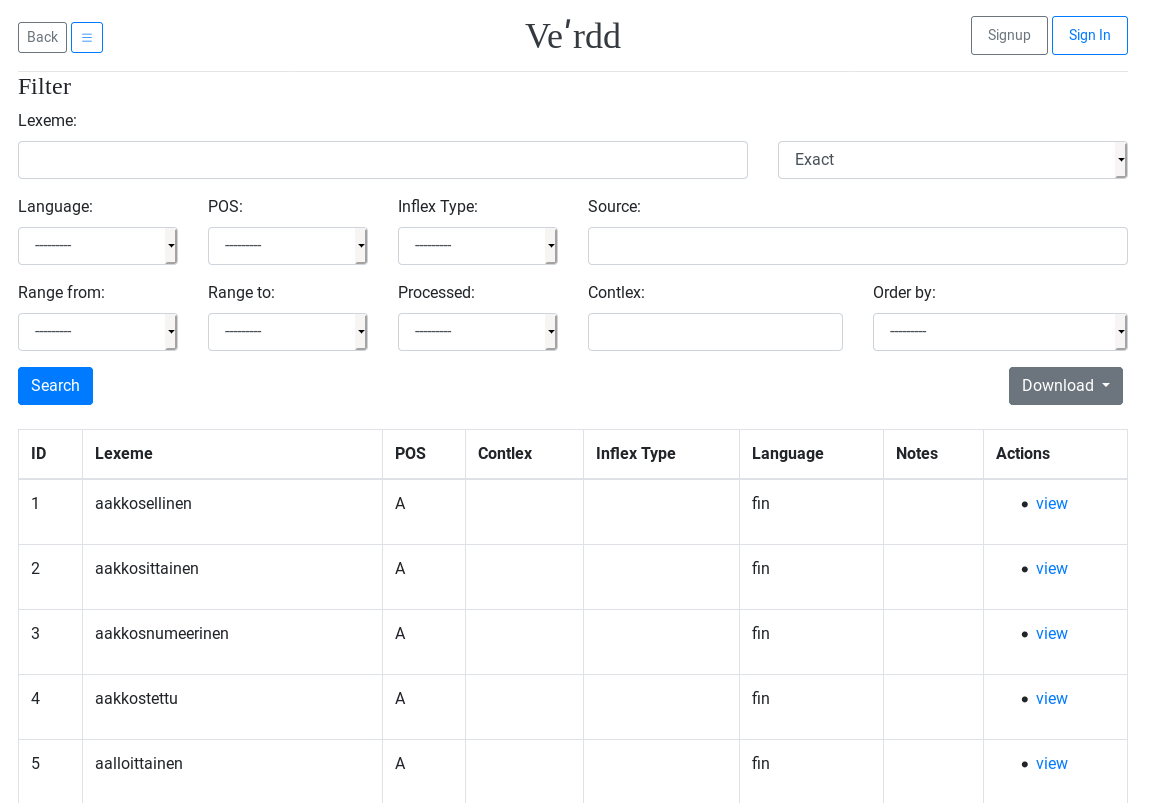
Veʹrdd is rich in features, the main ones are:
- Ability to visually add, edit, annotate, approve and delete dictionary entries such as lexemes, stems, relations (e.g. translations) and mini-paradigms.
- Use of transducers and UralicNLP to automatically generate mini-paradigms.
- Search and filter lexemes and relations.
- Bulk approve lexemes and relations.
- Logging all actions and reverting back to previous instances in case of an error.
- Link lexemes to external sources for further information.
- Automatically import dictionary entries from Giella's and Apertium's XML, LEXC and CSV files.
- Automatically export stored information in Veʹrdd in Giella's and Apertium's XML, LEXC and CSV formats.
- Automatically export a printable dictionary (in LaTeX).
For further information (e.g. installation, usages and localization), visit the wiki.
Staff members sign in to the LangJack Ve'rdd Workbench with their own Ve'rdd username (or e-mail address) and password: POST /api/v1/auth/login/ checks them and returns the account's API token (the same one manage.py create_api_token USER makes). Only staff and superusers can sign in. To revoke a token, delete it under Auth Token → Tokens in the Django admin.
To limit what a staff member can reach, add rows under Language access in the Django admin: each row is one language pair (unordered; sms and fin covers sms→fin and fin→sms), or one language twice for that language on its own. A staff user without rows is not limited; superusers never are. With rows the user sees and changes only entries and examples of those languages and translations of those pairs; merging or splitting an entry is refused while it carries translations of other pairs. The limit applies to the API (the Workbench), not to the Ve'rdd website's own pages.
- Alnajjar, K., Hämäläinen, M., Rueter, J., & Partanen, N. (2020). Ve’rdd. Narrowing the Gap between Paper Dictionaries, Low-Resource NLP and Community Involvement. In M. Ptaszynski, & B. Ziolko (Eds.), Proceedings of the 28th International Conference on Computational Linguistics: System Demonstrations International Committee on Computational Linguistics.
- Alnajjar, K., Hämäläinen, M., & Rueter, J. (2020). On Editing Dictionaries for Uralic Languages in an Online Environment. In Proceedings of the Sixth International Workshop on Computational Linguistics of Uralic Languages (pp. 26–30). Stroudsburg, PA: The Association for Computational Linguistics.
- Alnajjar, K., Hämäläinen, M., Partanen, N., & Rueter, J. (2019). The Open Dictionary Infrastructure for Uralic Languages. In Электронная Письменность Народов Российской Федерации: Опыт, Проблемы И Перспективы (pp. 49-51). Ufa: Башкирская энциклопедия.