███╗   ██╗███████╗██╗  ██╗ █████╗     ███╗   ███╗ █████╗ ██╗  ██╗███████╗███████╗██╗  ██╗
████╗  ██║██╔════╝██║  ██║██╔══██╗    ████╗ ████║██╔══██╗██║  ██║██╔════╝██╔════╝██║  ██║
██╔██╗ ██║█████╗  ███████║███████║    ██╔████╔██║███████║███████║█████╗  ███████╗███████║
██║╚██╗██║██╔══╝  ██╔══██║██╔══██║    ██║╚██╔╝██║██╔══██║██╔══██║██╔══╝  ╚════██║██╔══██║
██║ ╚████║███████╗██║  ██║██║  ██║    ██║ ╚═╝ ██║██║  ██║██║  ██║███████╗███████║██║  ██║
╚═╝  ╚═══╝╚══════╝╚═╝  ╚═╝╚═╝  ╚═╝    ╚═╝     ╚═╝╚═╝  ╚═╝╚═╝  ╚═╝╚══════╝╚══════╝╚═╝  ╚═╝


CS junior @ Purdue University — Machine Intelligence track, Mathematics minor. Currently SWE Intern @ Qualcomm, where I architect an autonomous, agentic crash-triage pipeline: an LLM-driven tool-use loop that ingests raw modem crash reports, autonomously resolves build artifacts, retrieves source context, and localizes root cause before a human engineer ever opens the log.
The thesis behind everything I build: LLMs stop being toys and start being infrastructure the moment you give them tools, guardrails, and a reason to act. I design that layer.
Off the keyboard: Project Team Lead @ ML@Purdue · Marketing Lead @ Girls Who Code Purdue
hetero-serve — KV-Cache-Aware LLM Serving Scheduler + CUDA Paged-Attention Kernels
[ CUDA kernels ] [ LLM inference ] [ distributed systems ] [ profiler-driven optimization ]
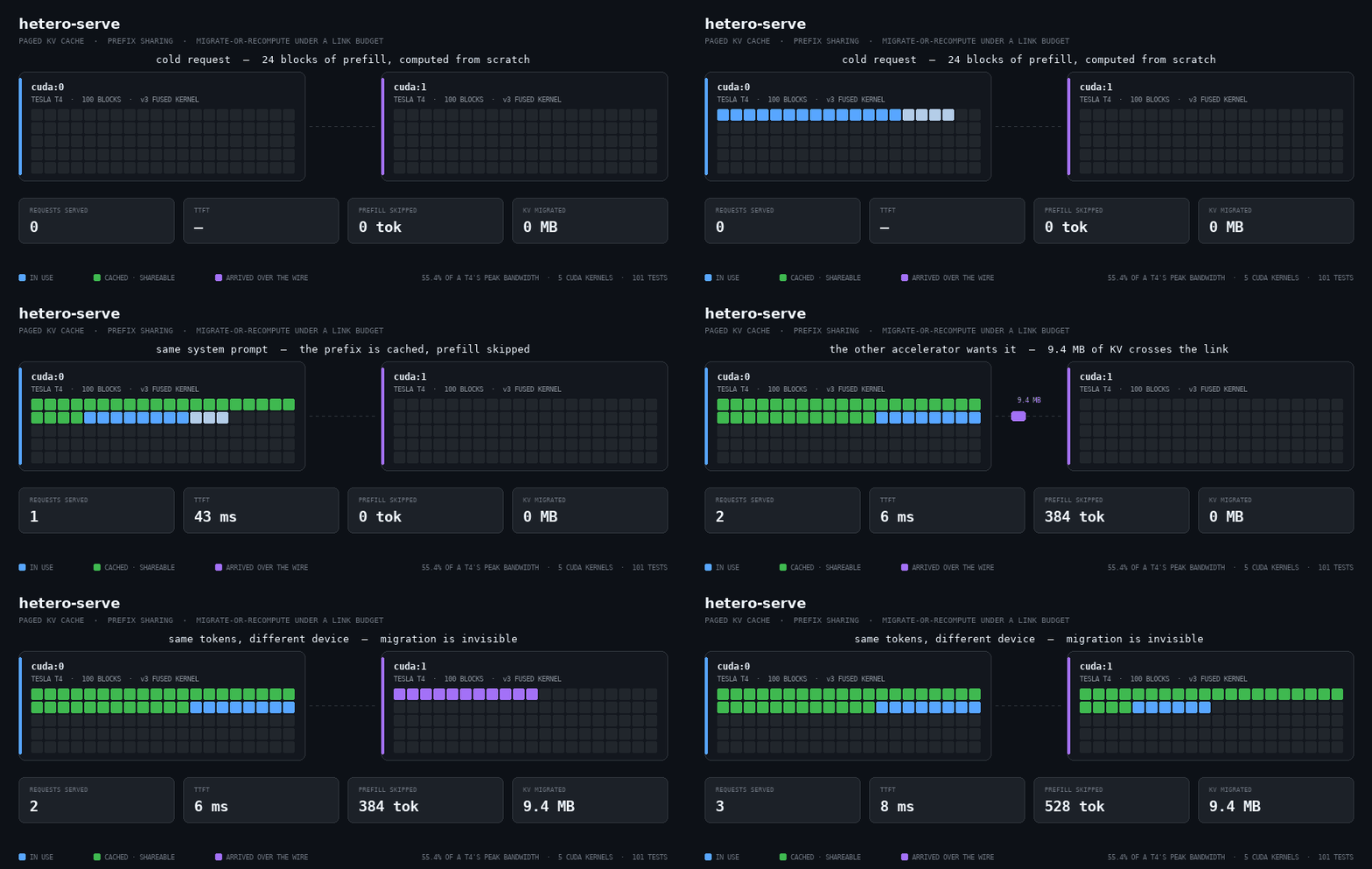
↑ live from the repo: a prefix fills, the next request reuses it instead of recomputing, then the cache crosses the interconnect. · ▶ drive it yourself in the browser →
When a request shares a long prefix with an earlier one — a system prompt, a RAG document, an earlier turn — its KV cache already exists, but on the wrong accelerator. You can run it where the cache is and wait behind a busy device, recompute the prefix from scratch, or drag the cache across the interconnect. That third option is a bandwidth-versus-compute trade, and this is a serving system built to find where it flips: a paged KV cache with 16-token blocks, refcounts, chain-hashed prefix sharing and LRU eviction; continuous batching with chunked prefill and recompute-preemption; and a router whose cost model prices stay against migrate in seconds, using per-device speeds it measures at startup rather than assumes. Workers are real OS processes over real TCP through a token-bucket shaper, so concurrent transfers genuinely contend — at 50 Mbps moving an 18.9 MB prefix loses to recomputing it, at 10 Gbps it wins, and cache-aware routing cuts end-to-end p50 from 3.60 s to 1.94 s by having it both ways: the highest hit rate and spread load.
Then profiling said a third of every decode step was not accelerator time at all — it was the host gathering KV blocks into contiguous tensors, overhead invented by paging the cache. So I wrote the kernel that deletes it, and then three more. v1 fuses the gather away; v2 adds FlashAttention-style online softmax so no score vector is ever materialised; Nsight then showed v2 was occupancy-starved rather than bandwidth-starved — 0.1 waves across 40 SMs, memory at 13.7%, compute at 11.3% — which produced v3, a context split that took it from 13.4% to 55.4% of a Tesla T4's peak memory bandwidth, or 10–22× PyTorch's own SDPA on paged data. Sweeping the split count caught my own heuristic being wrong: it targeted occupancy and picked 2 where 32 was 2.1× faster, because the online softmax is sequential and splitting shortens a dependent chain, not a wave count. There is also a prefill kernel (S query rows, causal, straight off the block table) and a tensor-core version where a 16-token KV page is exactly one 16×16×16 WMMA fragment — which is why block_size = 16 was the right default before any of this existed. Grouped-query attention is supported throughout, and it moves the scheduler's answer: Llama-3's 4:1 ratio cuts the cache 4× and drops the migration crossover from 503 Mbps to 126 Mbps — from needing a datacenter fabric to working on commodity networking.
101 tests, no mocks — real processes, real sockets, kernels fuzz-tested against a numpy oracle and against each other. Five bugs are documented in the README, every one found by measuring rather than reading: a cost model that priced transfers against an idle link, "measured" device speeds that were really measuring the queue, a rejected request that hung forever, a multi-megabyte memcpy held under the engine lock, and a process group that deadlocked on the very workers meant to join it. The one I'd keep: I was confident the fourth was a serialisation-layout problem, benchmarked it first, and was wrong — that path was 5.8 ms. Profile before optimising applies to your own hypotheses too.
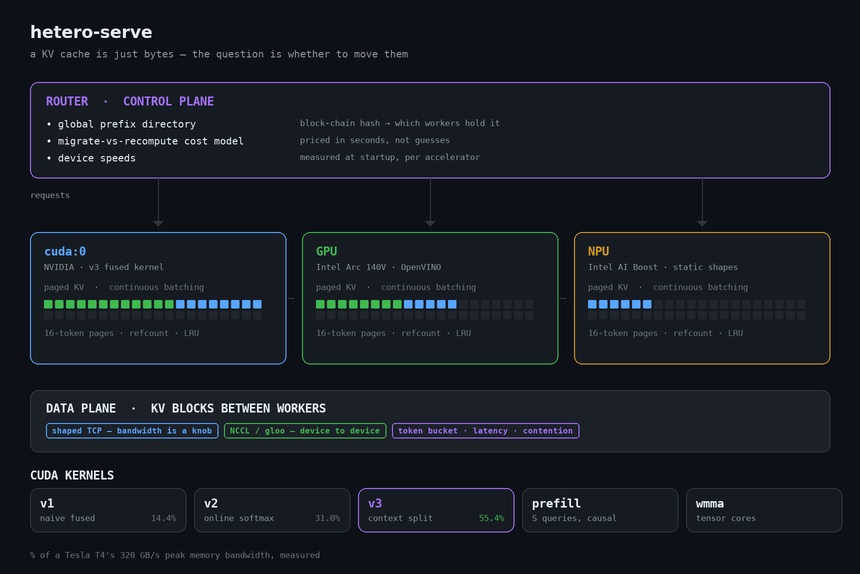
router decides where, each worker decides when · ▶ compile the kernels on a free Colab GPU →
CUDA C++ WMMA / tensor cores Nsight Compute PyTorch NumPy paged attention FlashAttention grouped-query attention NCCL / torch.distributed asyncio Docker OpenVINO
attnc — Python-Embedded DSL + JIT Compiler for Fused CUDA Attention
[ compiler design ] [ CUDA codegen ] [ symbolic tracing ] [ GPU inference ]
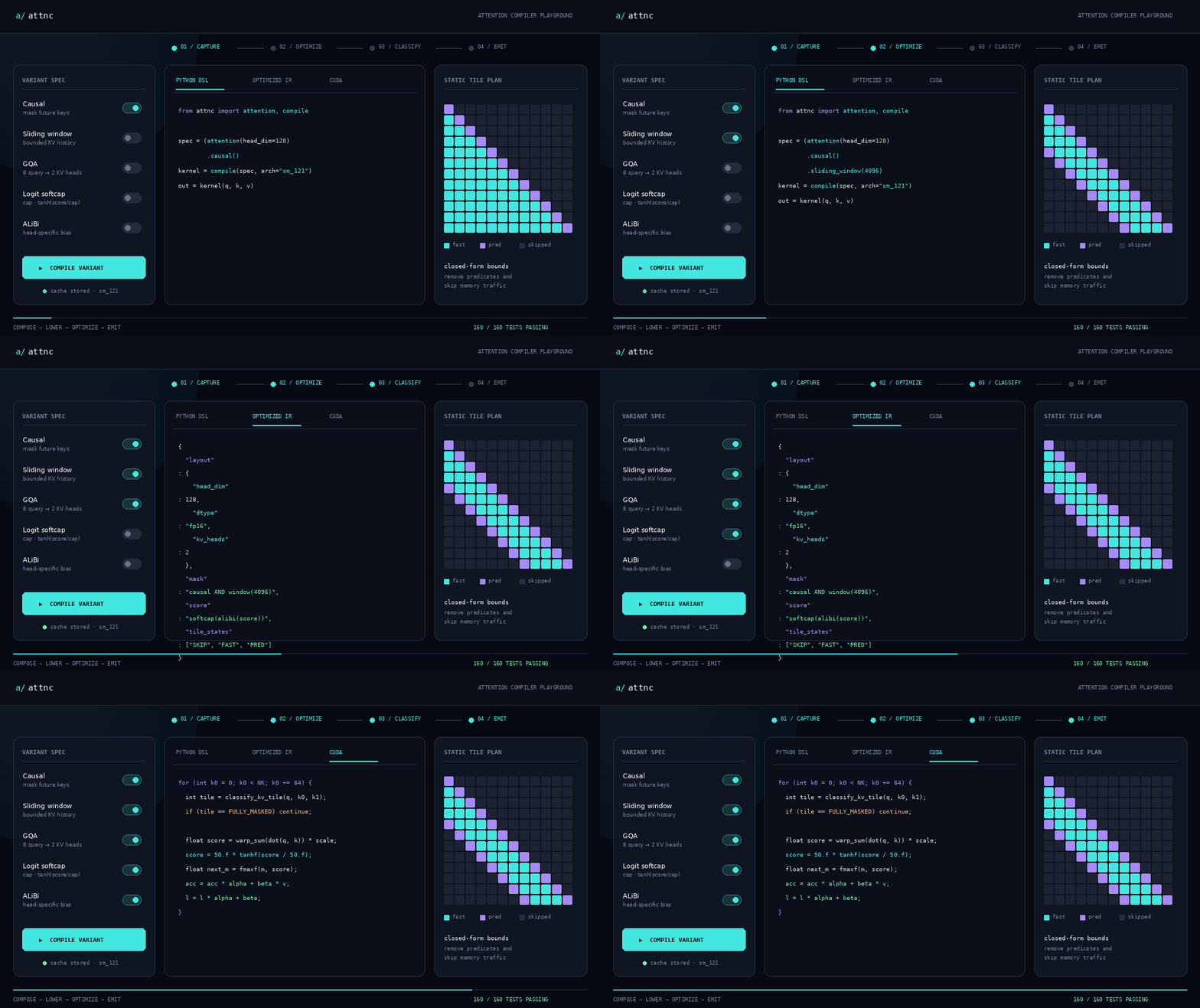
↑ live compiler explorer: compose an attention variant and watch the Python DSL, optimized IR, CUDA body, and static tile plan change together. · ▶ try it in the browser →
Attention kernels are fast when they are hand-tuned—and rigid when the model changes. attnc treats causal masking, sliding windows, GQA, logit softcaps, and ALiBi as a small program: two Python frontends lower into a shared IR, compiler passes simplify expressions and classify key tiles as skipped, fast, or predicated, and an NVRTC backend emits one fused online-softmax CUDA kernel. An independent NumPy interpreter anchors the correctness story with 160 randomized differential cases across variant compositions, GQA layouts, and non-square decode shapes.
Figment — Self-Play Market-Making Arena for Figgie
[ market microstructure ] [ Bayesian inference ] [ evolutionary self-play ]
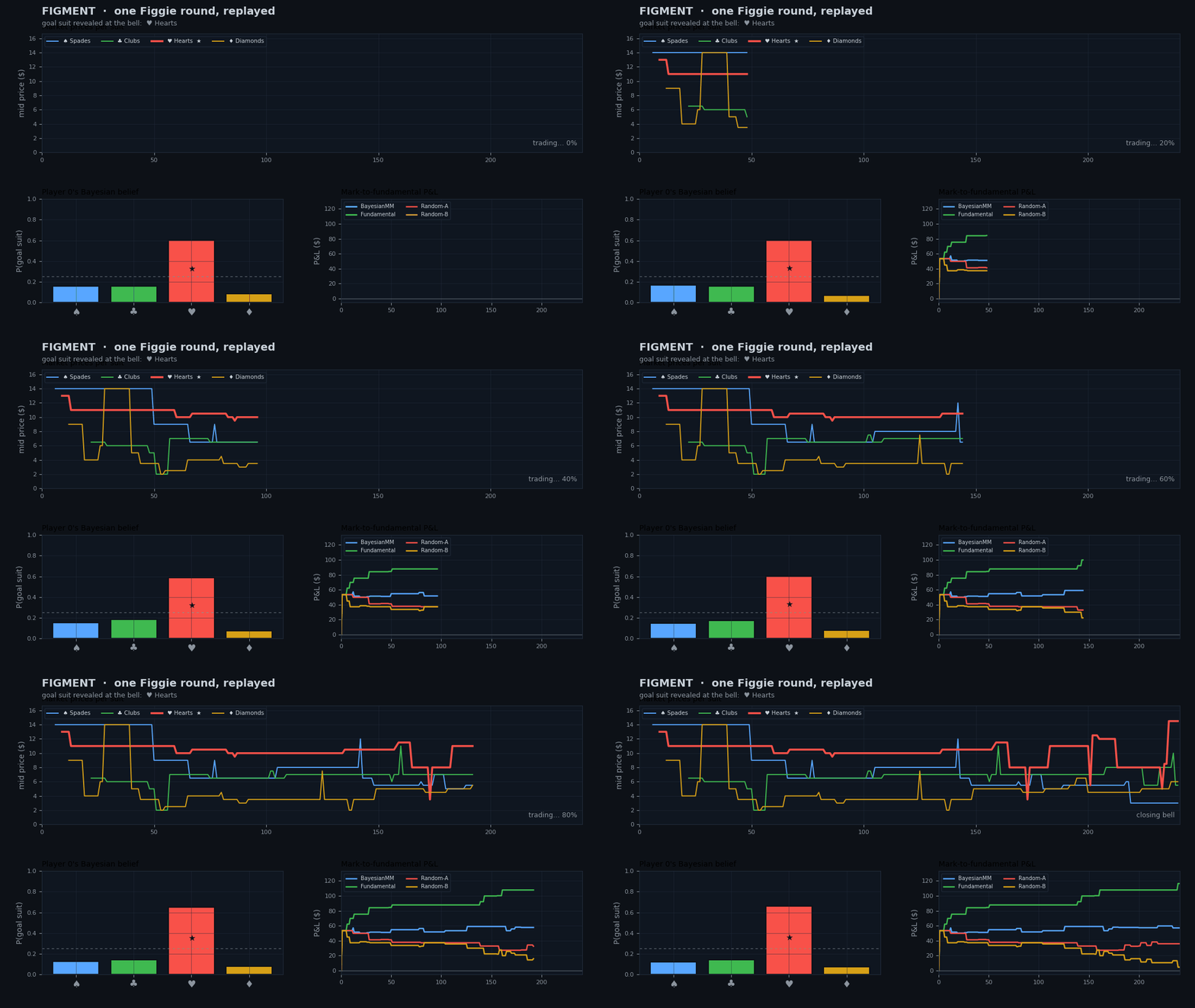
↑ live from the repo: one real round replayed — suit prices, the maker's belief converging on the hidden goal suit, and P&L. · open the repo →
A from-scratch engine for Figgie — the trading card game Jane Street invented to teach market intuition — plus AI traders that have to reason about a hidden market rather than pattern-match one. Underneath sits a continuous double auction with four independent order books, price-time priority, and exact settlement, and on top of it a Bayesian market maker that infers which suit secretly scores from its private hand and the order flow it observes — an exact multivariate-hypergeometric posterior, no black box — then prices every card at expected value and quotes a two-sided market Avellaneda–Stoikov style, skewing against inventory and widening its spread with belief entropy. An evolutionary self-play loop learns a market-making strategy from a deliberately timid start (+$6/game → +$37/game over 14 generations), and a multiplayer Elo tournament ranks the field. The result that makes the whole thing click: the noise traders win the pot more often yet lose money every game — because they overpay for it. Edge ≠ outcome, which is the entire game. Deterministic under a seed and pinned by 15 tests asserting the market never creates or destroys a card or a dollar.
Python NumPy Bayesian inference Avellaneda–Stoikov market-making evolutionary optimization multiplayer Elo matplotlib
PARALLAX — Multi-Agent Reliability Investigation Platform
[ agentic orchestration ] [ multi-agent systems ] [ autonomous investigation ]
A hierarchical multi-agent system built on the orchestrator-workers pattern: a director agent decomposes reliability incidents into a task graph and fans out to specialized statistical worker agents in parallel, each operating with an isolated toolset and context. Results fan back in through a cross-validation layer that reconciles conflicting findings before synthesis — because a multi-agent system without verification is just N chances to hallucinate. Handles failure isolation per-worker (one agent dying doesn't kill the investigation) and produces structured, evidence-linked root-cause reports. It's the difference between an LLM that summarizes an incident and a system that investigates one: hypothesis generation, statistical testing, dead-end pruning — autonomously.
TypeScript orchestrator-workers architecture parallel task decomposition fault isolation structured LLM outputs
VibeGraph — Bidirectional Code-Canvas Workflow IDE
[ AI workflow tooling ] [ real-time bidirectional sync ] [ static analysis ]
An IDE for agentic workflows where YAML source and a visual DAG are two projections of one canonical state — edit either, and a bidirectional reconciliation engine syncs them in real time without drift or destructive rewrites. The interesting engineering lives underneath: a custom static analyzer performs variable scope resolution and data-flow validation across workflow steps, catching broken references before execution — compiler techniques applied to workflow definitions. A step-through simulator works like a debugger for agent pipelines (breakpoints, state inspection, deterministic replay), and layout is handled by ELK's layered graph algorithm for readable auto-arrangement of arbitrary DAGs. Shipped with 33 passing tests across the sync engine and analyzer, because developer tooling doesn't get to be flaky.
Next.js React Flow Monaco Zustand static analysis bidirectional state reconciliation DAG layout algorithms
Sentinel — AI-Driven Sensor Anomaly Workbench
[ anomaly detection ] [ AI decision support ] [ real-time telemetry ]
A multi-channel anomaly triage workbench that ingests streaming sensor telemetry and layers AI-driven decision support on top — classifying deviations as noise, drift, or imminent failure, with cross-channel correlation to distinguish a failing sensor from a failing system. Designed around a production-reliability truth: alert fatigue kills monitoring systems faster than missed alerts do. Every flag ships with its supporting evidence, correlated channels, and a recommended action, keeping the human in the loop deciding instead of deciphering. Explainability isn't a feature here — it's the architecture.
TypeScript streaming telemetry ingestion cross-channel correlation explainable AI human-in-the-loop systems
MERIDIAN — Zero-Backend Self-Service BI Platform
[ analytics infrastructure ] [ in-browser compute ] [ data democratization ]
A full business-intelligence platform with a deliberately contrarian architecture: the entire compute layer moved client-side. An in-browser SQL engine (AlaSQL) executes queries directly over uploaded datasets, and visualization runs on a charting engine hand-rolled from raw SVG primitives — no chart library, no rendering dependency, full control over every pixel and every render pass. The result: zero backend, zero infrastructure cost, zero data leaving the user's machine — a privacy-preserving analytics loop that collapses upload → query → visualize into a single client-side artifact. Built to interrogate a real systems tradeoff: how much of the modern data stack is architecture, and how much is habit?
Next.js in-browser SQL execution custom SVG rendering engine client-side compute zero-infrastructure design
PipelineForge — Visual Data Pipeline Architect
[ dataflow systems ] [ visual programming ] [ pipeline orchestration ]
A visual environment that models data pipelines as typed, composable DAGs — connect stages, trace data lineage end-to-end, and validate topology before anything touches production data. The design bet: pipeline failures are overwhelmingly architecture failures (implicit dependencies, untracked lineage, silent schema drift), so the tool makes the architecture inspectable first-class — you reason about the graph, not the glue code.
TypeScript Next.js DAG modeling data lineage topology validation
GridLens — High-Velocity Data Exploration
[ interactive analytics ] [ frontend performance engineering ]
Tabular data exploration engineered around a single latency budget: interaction must never lag behind thought. Filtering, slicing, and pattern-hunting across datasets with a front-end architecture tuned for render performance — because the moment an exploratory tool makes the analyst wait, the exploration ends. An exercise in treating UI latency as a systems problem, not a styling problem.
TypeScript Next.js interaction-latency optimization render performance
QueryDesk — Conversational Analytics Workspace
[ natural-language data access ] [ query UX ]
A workspace built for the pattern every data tool is converging on: the query interface is a conversation, not a syntax exam. Ask in natural language, refine iteratively, drill down — collapsing the distance between a question and its answer for users who shouldn't need to know what a LEFT JOIN is to get one.
TypeScript Next.js natural-language querying iterative refinement UX
POSTUREGUARD    Edge-AI wearable running the full inference pipeline on-device:
                MediaPipe pose estimation feeding a custom-trained LSTM on a
                Raspberry Pi, closing the control loop through Arduino haptic
                feedback. Real-time sequence classification under embedded
                compute and memory constraints — no cloud in the loop.

BOILEREXCHANGE  Campus marketplace shipped by a 7-person team: Next.js front-end,
                Django Ninja API, PostgreSQL, Algolia full-text search, and
                Stripe payment infrastructure. Real users, real money, real
                consequences for bad schema decisions.

NEURALDRIVE     Autonomous navigation stack in C++/PyTorch deployed on a Jetson
                Nano — the full perception-to-control loop running on
                GPU-accelerated embedded hardware.

OPEN SOURCE     Active contributions in flight: freeCodeCamp, OpenMRS (global
                open-source EMR platform serving clinics worldwide).
────────────────────────────── A R S E N A L ──────────────────────────────








Deep in: agentic architectures (ReAct, orchestrator-workers, plan-and-execute) · LLM tool-use & function calling · RAG systems · GPU programming · embedded ML
──────────────────── C O M M I T H I S T O R Y ────────────────────