
🧫 I built a swarm brain for autonomous machines — powered by a GPU, inspired by slime mold. No central controller. No cloud. No single point of failure. It's called Slime Flow. Here's what it does: → 512 agents coordinate using pheromone trails — no instructions, no map, no leader → Fault zones appear — the swarm reroutes in milliseconds → Rogue agents infiltrate — Veilpiercer detects them, scores their anomaly, quarantines them live → All of it running on an RTX 4060, streamed to the browser in real time The same logic slime mold has used for 500 million years. Applied to drones, robots, and AI agent networks. Demo: https://youtu.be/UiYcXbyOEvQ Repo: https://github.com/flipperspectives-crypto/slime-flow Open to conversations with anyone building autonomous systems who needs a coordination layer that actually survives chaos. #swarmAI #autonomoussystems #biomimetic #drones #robotics #AIinfrastructure #Julia #CUDA
Biomimetic swarm intelligence for autonomous machines — no central controller, no cloud, no surveillance.


Self-host free forever (SLIMEFLOW_BILLING=0). Quarantine real rogue agents → Option D. Looking for design partners → issue #2. Support → GitHub Sponsors (pending approval).
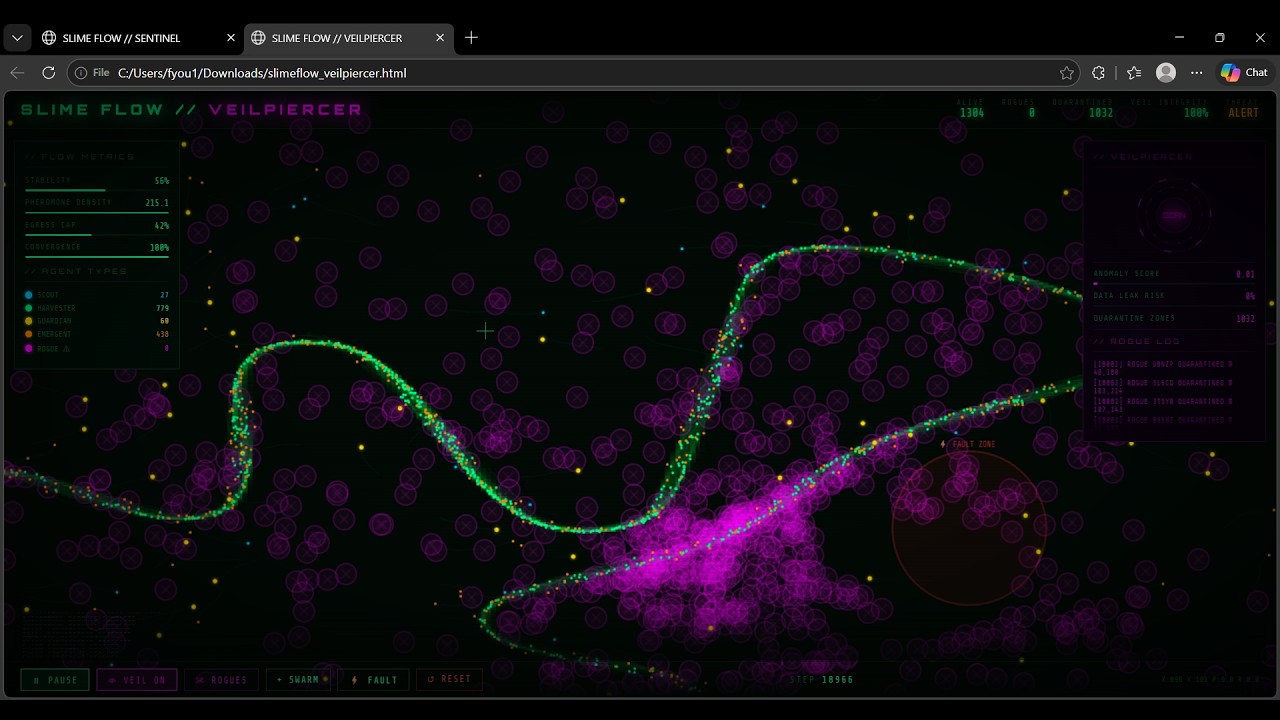
▶ Watch the live GPU demo on YouTube
RTX 4060 running Julia CUDA kernels → streamed live to browser. Rogues infiltrating, Veilpiercer quarantining, fault zone forcing swarm reroute in real time.
Slime mold has navigated mazes, found optimal paths, and survived chaos for 500 million years — without a brain, without a leader, without a map.
Slime Flow applies the same principles to autonomous machines: self-driving vehicles, drone swarms, warehouse robots, and AI agent networks.
Three layers:
| Layer | Role |
|---|---|
| Slime Flow | Living pheromone trails that grow, pulse, and reroute with no central controller |
| Sentinel | Protective membrane monitoring swarm survivability, flow stability, and egress capacity in real time |
| Veilpiercer | Rogue agent detection, behavioral anomaly scoring, data leak monitoring, and quarantine |
No cloud dependency. No central server. Runs fully offline on edge hardware.
Open slimeflow_veilpiercer.html directly in any browser.
| Button | Action |
|---|---|
👁 VEIL ON/OFF |
Toggle rogue detection — turn it off and watch chaos spread |
☠ ROGUES |
Spawn 8–16 rogue agents near existing clusters to blend in |
⚡ FAULT |
Inject a kill zone — Guardians are immune, others reroute |
↺ RESET |
Full reset |
| Click canvas | Drop a pheromone burst anywhere |
julia server.jl
Then open slimeflow_live.html in Chrome. Connects to localhost:8080 and renders live GPU frames at ~18 FPS. See BRIDGE.md for full setup.
pip install -e python-sdk/from slimeflow import SlimeFlow
sf = SlimeFlow()
sf.spawn_rogues()
for frame in sf.stream(max_frames=100):
print(f"Step {frame.step}: {frame.rogue_count} rogues, integrity {frame.integrity():.0f}%")See python-sdk/README.md for full API docs. Async + numpy support available.
| Agent | Count | Behavior |
|---|---|---|
| 🔵 Scout | 80 | Fast, exploratory, weak pheromone sensing — often ignores trails |
| 🟢 Harvester | 200 | Slow, heavy deposit — classic slime mold pathfinding |
| 🟡 Guardian | 60 | Patrols boundaries, survives fault zones |
| 🟠 Emergent | 80 | Adaptive speed and deposit, responds to flow pressure |
| 🟣 Rogue | 0 (spawned) | Chaotic movement, invisible pheromone signature, builds anomaly score |
Every agent carries an anomaly score. Rogues accumulate +0.08 per step. Normal agents decay -0.002 per step.
When a rogue's anomaly score exceeds 0.6, Veilpiercer quarantines it — drawn with a purple X ring, removed from the flow, logged to the event console.
Rogues leave a separate rogue_pheromone trail (purple overlay when Veil is ON). With Veil OFF, rogue trails spread undetected across the entire swarm.
The core pheromone engine runs GPU-accelerated on CUDA via Julia:
using CUDA

const W, H = 128, 128
const N_AGENTS = 512

pheromone = CUDA.zeros(Float32, W, H)
ax = CUDA.rand(Float32, N_AGENTS) .* W
ay = CUDA.rand(Float32, N_AGENTS) .* H

# Live output:
# Device: NVIDIA GeForce RTX 4060 Laptop GPU
# Serving on http://localhost:8080 at ~18 FPS
Tested on: NVIDIA RTX 4060 Laptop GPU (8GB VRAM), Julia 1.12, CUDA 13.2, Driver 595.71.0
Income flywheel + prepaid metering: see MONETIZE.md.
$0 bootstrap: FREE_LAUNCH.md · SPONSORS.md · LAUNCH_POSTS.md
Same Veilpiercer threshold (0.6), but for live agents — not the pheromone sim.
pip install -e python-sdk/
python -m slimeflow.server --host 127.0.0.1 --port 8080
python python-sdk/examples/rogue_agent_demo.py
In-process gate before high-impact tools:
from slimeflow import guard

gate = guard.check("my-bot")
if not gate["allowed"]:
    raise RuntimeError(gate["reason"])

result = guard.report(
    "my-bot",
    "send",
    tool="gmail.send",
    detail="outreach blast",
    user_confirmed=False,  # will quarantine fast
)
HTTP: GET /agents, POST /agents/report, GET /agents/{id}/check,
POST /agents/{id}/release, POST /agents/{id}/quarantine.
- GPU pheromone simulation (Julia + CUDA)
- 5 agent types with emergent behavior
- Veilpiercer rogue detection + quarantine
- Fault injection + self-healing
- Live HTML visualization dashboard
- Julia → browser bridge (live GPU stream)
- Python SDK
- Rust SDK
- ROS2 integration for real hardware
- Edge deployment (Jetson Nano / Raspberry Pi)
- Enterprise privacy audit logs
- Autonomous vehicles — organic rerouting without cloud map updates
- Drone swarms — mission continues when agents are lost
- Warehouse robots — no central scheduler, bottlenecks dissolve automatically
- AI agent networks — Veilpiercer catches prompt injection and rogue behavior
- Critical infrastructure — decentralized mesh with no single point of failure
Current autonomous systems are fragile by design: one server goes down, the swarm freezes. One breach, everything is exposed. One outage, the fleet stops.
Nature solved this differently. Slime Flow is built on the same principles nature used — emergent, decentralized, fault-tolerant, and 100% private by default.
No telemetry. No cloud dependency. No surveillance.
MIT — see LICENSE
On The Lolo — AI Infrastructure
flipperspectives@gmail.com